The Prophecy That Laughed
In January 1964, Stanley Kubrick released a film so dangerous that Columbia Pictures attached a disclaimer insisting the United States Air Force’s safeguards would prevent the events depicted from occurring. The film was Dr. Strangelove or: How I Learned to Stop Worrying and Love the Bomb. It told the story of an insane American general who launches an unauthorized nuclear strike, a War Room full of leaders who cannot recall the planes, a Soviet Doomsday Machine designed to retaliate automatically — and the calm, smiling German scientist in a wheelchair who explains, with perfect logic, why the annihilation of the human race is not a bug in the system but a feature.
The audience laughed. The critics applauded. The film became one of the greatest satires in the history of cinema. Everyone understood that it was a joke — a brilliant, terrifying, absurdist joke about the impossibility of rational men navigating irrational systems toward anything other than catastrophe.
It is February 27, 2026. Two American aircraft carrier strike groups are converging on the Arabian Sea. Over five hundred combat and support aircraft have been staged across the Middle East. Six governments have evacuated their citizens from Iran. An ayatollah has sealed the door to diplomacy from a pulpit. Russia has handed America’s strike plan to the enemy. China has armed the enemy’s navy with ship-killing missiles while pulling its own people out of the blast zone.
Nobody is laughing now.
Because Kubrick’s joke was never a joke. It was a diagnosis. And sixty-two years later, we are living inside the film.
Scene One: General Ripper’s Office
DR. STRANGELOVE, 1964
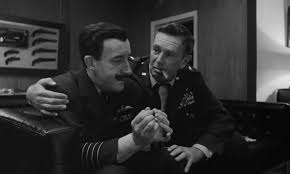
Brigadier General Jack D. Ripper, commander of Burpelson Air Force Base, locks himself in his office, issues orders to his B-52 wing to proceed to their Soviet targets under “Wing Attack Plan R,” and seals the base against any communication from the outside world. He acts alone. He acts without authorization. He acts because he has convinced himself that the threat is so existential that waiting for democratic process is itself the danger.
When his aide, Group Captain Mandrake, tries to reason with him, Ripper explains his logic with absolute calm. He is not mad, he insists. He is the only one willing to act.
The genius of Kubrick’s Ripper is that he is not a caricature. He is the logical endpoint of a system that trains men to believe that the enemy is existential, that the threat is always imminent, and that hesitation is surrender. Ripper does not malfunction. He functions — he executes exactly what the system taught him to do, just without the one constraint the system assumed would always hold: the chain of command.
Now look at the configuration of February 2026. The largest American military buildup in the Middle East since the 2003 invasion of Iraq was not authorized by Congress. No declaration of war has been issued. No formal vote has been taken. The deployment of two carrier strike groups, over a hundred fighter jets, two hundred cargo planes, a hundred fuel tankers, F-22s to Israeli bases, E-3 command aircraft to Saudi Arabia, and approximately eleven thousand additional service members was executed under existing executive authority. The American public was not consulted.
In Dr. Strangelove, General Ripper bypasses the system. In 2026, the system bypassed itself. No one had to go rogue. The architecture of executive war-making has been refined over sixty years to the point where the largest military deployment in a generation can be executed as an administrative decision. The planes do not need General Ripper. General Ripper has been automated.
Kubrick’s nightmare was a system that could be hijacked by madness. The actual nightmare is a system that no longer needs madness. It runs on momentum.
Scene Two: The War Room
DR. STRANGELOVE, 1964
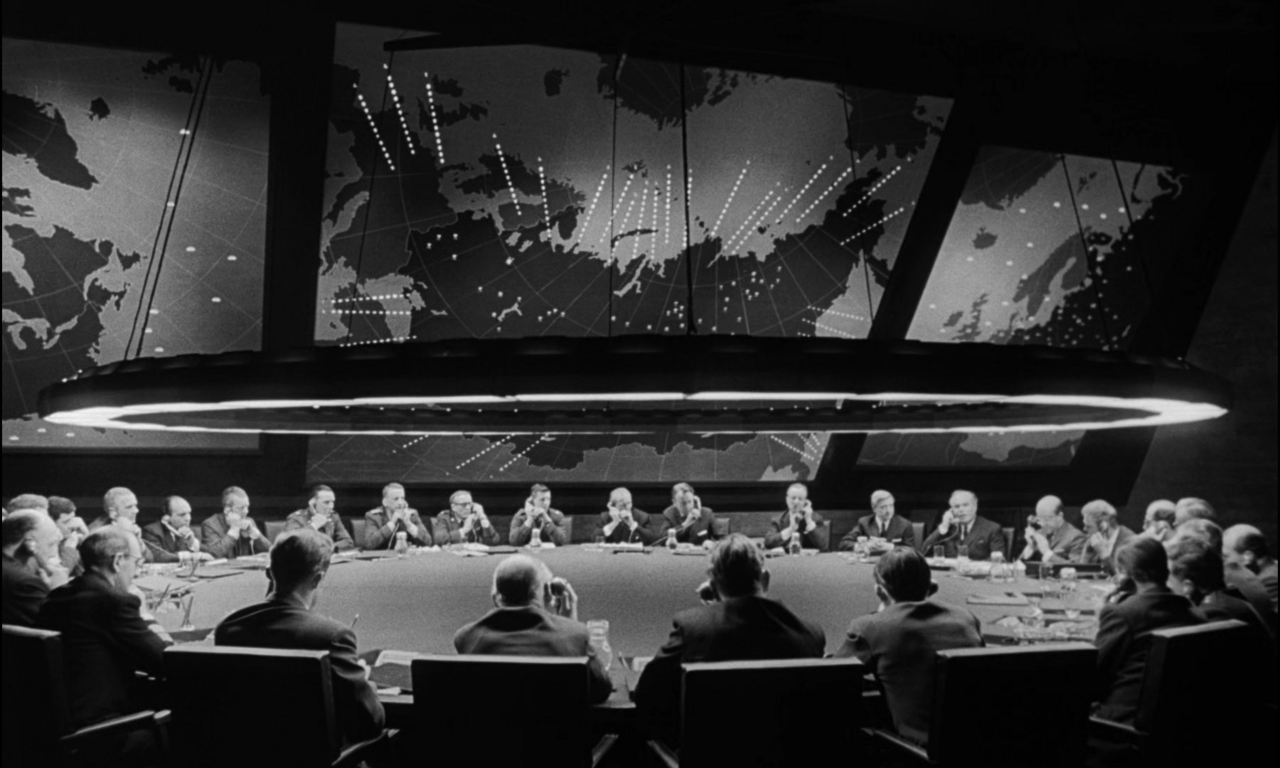
President Merkin Muffley sits at the circular table of the Pentagon War Room, surrounded by generals, advisors, and the Soviet Ambassador. General Turgidson lobbies for escalation, carrying a binder labeled “World Targets in Megadeaths.” Dr. Strangelove sits in his wheelchair, smiling.
The most famous line in the film belongs to President Muffley, who scolds the bickering men: “Gentlemen, you can’t fight in here! This is the War Room!”
Kubrick understood something that most political commentators still do not: the War Room is not where wars are prevented. The War Room is where the impossibility of preventing war becomes a spectacle of rational men performing rationality while the machinery they built operates beyond their control.
President Muffley is not stupid. He is not evil. He is a reasonable man trapped in a system that has made reasonableness irrelevant. He is the most powerful man in the world sitting in the most fortified room in the world, and he is powerless — because the systems designed to protect him have been designed to operate without him.
The parallel is not metaphorical. It is structural. In both cases — 1964 and 2026 — the systems designed to provide security have created their own logic of escalation, a logic that operates independently of any individual’s desire for peace and that punishes restraint more severely than it punishes aggression.
Scene Three: The Doomsday Machine
DR. STRANGELOVE, 1964
The Soviet Ambassador reveals that the USSR has built a Doomsday Machine — a network of buried nuclear devices rigged with cobalt-thorium G, designed to detonate automatically upon detection of any nuclear attack. The machine cannot be deactivated. That is the point.
President Muffley asks: “But how is it possible for this thing to be triggered automatically and at the same time impossible to untrigger?”
Strangelove replies: “Mr. President, it is not only possible, it is essential. That is the whole idea of this machine.”
The Doomsday Machine is the most important concept in the film. Kubrick did not invent it. He borrowed it from Herman Kahn, the RAND Corporation nuclear strategist whose book On Thermonuclear War used the Doomsday Machine as a thought experiment to illustrate the logical endpoint of deterrence theory. Kahn’s worry was not that the machine was impossible. His worry was that the military might think it was a good idea.
In 2026, the Doomsday Machine is not a buried network of cobalt bombs. It is the interlocking web of commitments, alliances, and automated responses that ensure any single point of ignition in the Middle East cascades into a multi-theater conflagration that no single leader can stop.
If the United States strikes Iran, Iran retaliates against American bases. If Iran retaliates, Hezbollah attacks Israel. If the Strait of Hormuz closes, twenty percent of the world’s oil vanishes. If conflict expands, Iran-backed militias engage. Russia has warned of “serious consequences.” China has armed Iran’s navy while evacuating its own citizens. And the CRINK axis — China, Russia, Iran, North Korea — functions as a distributed Doomsday Machine: no single treaty, no single command, no single point of deactivation.
“The whole point of the Doomsday Machine is lost if you keep it a secret! Why didn’t you tell the world?” The world was told. It watched. It scrolled past.
Scene Four: The General’s Warning
Three years before Kubrick released Dr. Strangelove, on January 17, 1961, President Dwight David Eisenhower — the five-star general who commanded the Allied liberation of Europe — delivered his farewell address to the American people. In fewer than ten minutes, he issued the most consequential warning in the history of the American presidency.
He warned of a new phenomenon: the permanent fusion of military establishments with civilian defense industries into the “military-industrial complex.” He acknowledged its necessity. But he warned that this conjunction carried within it the seeds of democratic destruction.
EISENHOWER’S FAREWELL ADDRESS, JANUARY 17, 1961
“In the councils of government, we must guard against the acquisition of unwarranted influence, whether sought or unsought, by the military-industrial complex. The potential for the disastrous rise of misplaced power exists and will persist. We must never let the weight of this combination endanger our liberties or democratic processes. Only an alert and knowledgeable citizenry can compel the proper meshing of the huge industrial and military machinery of defense with our peaceful methods and goals, so that security and liberty may prosper together.”
Eisenhower was not a pacifist. He was a warrior who understood that the machinery of war, once built, generates its own demand for use. Defense contractors need contracts. Generals need missions. Budgets need justifications. When the machinery is vast enough, the question ceases to be “Should we use it?” and becomes “Why are we not using it?”
Over five hundred aircraft have been deployed. Two carrier strike groups are in position. The political rhetoric has escalated to the point where retreat carries reputational cost. One analyst observed this week that if the President cancels the attack, he faces accusations of backing down — and the political cost of restraint becomes greater than the political cost of war.
This is the military-industrial complex’s ultimate achievement: a condition in which the existence of the machinery creates the political necessity for its use. Eisenhower foresaw it. Kubrick dramatized it. And on February 27, 2026, we are living it.
Scene Five: Major Kong Rides the Bomb
DR. STRANGELOVE, 1964
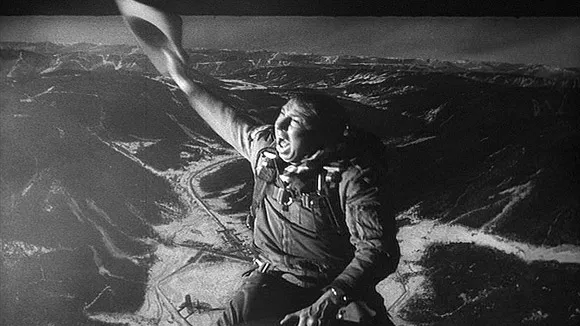
In the film’s most iconic image, Major T.J. “King” Kong straddles a hydrogen bomb as it falls from the B-52’s bomb bay. He waves his hat and whoops like a rodeo rider. The audience laughs. The bomb detonates. The Doomsday Machine activates. “We’ll Meet Again” plays over a montage of mushroom clouds.
Major Kong does not ride the bomb because he is suicidal. He rides it because, within his framework, he is a patriot. The system told him this was the mission, and he is executing the mission with gusto. He is not the villain. He is the product.
Now watch social media on any given evening in February 2026. Watch the carrier deployment videos set to dramatic music. Watch the satellite images of fighter jets shared with captions celebrating American power projection. Watch the commentary celebrating the size of the armada, the lethality of the platforms, the precision of the weapons — as if the deployment itself were the achievement, and the question of what happens when those weapons are used is an afterthought for lesser minds.
Watch the cheering.
Kubrick showed us a man riding a bomb to the end of the world with a smile on his face. We thought it was satire. It was journalism. He was just sixty-two years early.
The Punchline
Here is what Stanley Kubrick understood in 1964 that most of the world still has not absorbed in 2026:
The danger is not the madman. The danger is the system.
General Ripper is a catalyst, not a cause. The B-52s were already armed and airborne. The Doomsday Machine was already built. The War Room was already full of men whose careers depended on the machinery of annihilation. Ripper merely demonstrated what Eisenhower had warned: that the military-industrial complex, once granted unwarranted influence, generates its own logic, its own momentum, and its own justification for use.
Kubrick made it a comedy because he believed laughter might make people think. He chose satire over tragedy because he hoped the absurdity might shock the audience into demanding change.
It did not work.
Sixty-two years later, the systems Eisenhower warned about and Kubrick satirized have not been dismantled. They have been perfected. The military budget is larger. The executive war-making authority is broader. The defense industry is more intertwined with governance. And the Doomsday Machine has been distributed across four nuclear-armed or nuclear-threshold states whose interests converge on ensuring American military action costs the maximum possible.
Kubrick’s War Room was a set on a soundstage. The real War Room is the entire planet, and we are all sitting in it, and the film is not a film anymore. It is a documentary that was shot sixty-two years before the events it depicts.
Dr. Strangelove ended with Vera Lynn singing “We’ll Meet Again” over footage of nuclear explosions — the sentimental promise of reunion played against the visual evidence of extinction. It captured the fundamental human capacity to sentimentalize our own destruction, to wrap apocalypse in nostalgia, to watch the mushroom clouds rise and think, somehow, that this is not about us.
It is about us. It is about us tonight. It is about us at this hour, on this Friday, as the carriers move and the jets refuel and the diplomats fail and the ayatollah speaks and the Doomsday Machine hums beneath the surface of events, waiting — not for a command, but for the absence of one.
Kubrick saw it coming. Eisenhower warned us. We laughed. We applauded. We gave it awards.
And now we are inside the film, and there is no director to yell cut.
“We’ll meet again, don’t know where, don’t know when...”