OPINION
One Florida county holds the keys to our nuclear deterrent, space launch dominance, and missile defense. Our enemies know it. Do we?
There is a strip of Florida coastline, barely 72 miles long and in most places less than 10 miles wide, that quietly holds the fate of American national security in its hands. If an adversary—China, Russia, Iran, or a coordinated non-state actor—wanted to cripple the United States military’s ability to see, launch, detect, deter, and fight, there is one ZIP code that delivers more strategic damage per square mile than anywhere else on the planet.
That place is Brevard County, Florida. And almost nobody is talking about it.
We spend billions hardening the Pentagon. We built Cheyenne Mountain inside a granite fortress. We disperse nuclear bombers across the Great Plains. But in Brevard County, we have concentrated an almost incomprehensible density of irreplaceable defense assets—nuclear monitoring, submarine missile testing, space launch infrastructure, stealth bomber development, satellite manufacturing, and the headquarters of major defense contractors—all within a low-lying coastal corridor sitting seven feet above sea level on a barrier island.
If this sounds like a strategic planner’s nightmare, that’s because it is.
What Brevard County Actually Houses
Most Americans know Cape Canaveral as the place where rockets launch. That’s true—but it barely scratches the surface. Here is what is actually concentrated in this single Florida county:
The Nation’s Nuclear Watchdog
Patrick Space Force Base is home to the Air Force Technical Applications Center (AFTAC)—the Department of Defense’s sole nuclear treaty monitoring center. AFTAC operates more than 3,600 sensors worldwide through the U.S. Atomic Energy Detection System, the largest sensor network in the entire Air Force. These sensors detect nuclear detonations underground, underwater, in the atmosphere, and in space. AFTAC’s operations center runs 24 hours a day, 365 days a year, and its findings go directly to the President of the United States.
There is no backup AFTAC. There is no redundant facility. If this center goes dark, the United States loses its primary ability to detect whether Russia, China, North Korea, or Iran is conducting nuclear weapons tests. That is not a regional inconvenience—that is a global strategic blindspot.
The Sea-Based Nuclear Deterrent’s Nerve Center
The Naval Ordnance Test Unit (NOTU) at Cape Canaveral Space Force Station has been the backbone of America’s submarine-launched ballistic missile program since 1950. NOTU directly supports the readiness of the Navy’s Trident submarines—the most survivable leg of the nuclear triad—and also supports the United Kingdom’s Fleet Ballistic Missile program under allied agreements.
In February 2026, NOTU broke ground on a new 130,000-square-foot Engineering Test Facility to support the next-generation Trident II D5LE2 missile system. This is the weapon that will arm the Navy’s new Columbia-class nuclear submarines through the year 2084. The Navy has committed to 28 infrastructure projects at NOTU between 2024 and 2032, with a recently awarded contract alone valued at $165.7 million.
The institutional knowledge, specialized equipment, and classified testing capabilities housed at NOTU cannot be replicated quickly. Destroying this facility doesn’t just delay a program—it sets back the sea-based nuclear deterrent by years, possibly decades.
America’s Primary Space Launch Complex
Cape Canaveral Space Force Station is the primary launch site for the Space Force’s Eastern Range, with four active launch pads. Space Launch Delta 45 manages a 15-million-square-mile operational zone stretching from Florida across the Atlantic and into the Indian Ocean. In 2024 alone, the Eastern Range supported 93 launches, with projections of 107 in 2025.
Cape Canaveral’s position near the equator gives rockets an energy boost from Earth’s rotation that no other continental U.S. launch site can match. Vandenberg Space Force Base in California handles polar-orbit missions, but it cannot fully compensate for the loss of eastward-launch capability. Degrade Cape Canaveral and you cripple America’s ability to surge replacement satellites—reconnaissance, communications, GPS, missile warning—into orbit during a conflict.
The Defense Contractor Brain Trust
Brevard County isn’t just a launch site. It’s a defense industrial powerhouse. L3Harris Technologies—one of the top five defense contractors on Earth—is headquartered in Melbourne, Brevard’s largest city, and is the county’s third-largest employer. The company recently opened a $100 million satellite integration and test facility in Palm Bay and completed its $4.7 billion acquisition of Aerojet Rocketdyne, the nation’s leading rocket propulsion manufacturer.
Northrop Grumman’s Melbourne campus employs approximately 5,000 workers across 2 million square feet of office, lab, and manufacturing space. This is where engineers developed the B-21 Raider, America’s next-generation long-range stealth bomber—arguably the most important new weapons platform in a generation.
Lockheed Martin relocated its Fleet Ballistic Missile headquarters from California to Titusville, Florida, investing $40 million and moving all missile contracts to Brevard. Lockheed’s Orion deep-space crew vehicle is assembled on the Space Coast. Boeing, SpaceX, Blue Origin, United Launch Alliance, and Embraer all maintain major operations here. Blue Origin alone has invested over $1.5 billion in capital and built more than 1 million square feet of manufacturing, test, and launch facility space.
In total, Brevard County has received over $50 billion in defense contract awards. The aerospace workforce in the county nearly doubled from 2017 to 2023, climbing from 7,847 to 14,828 workers.
Space Force Command Infrastructure
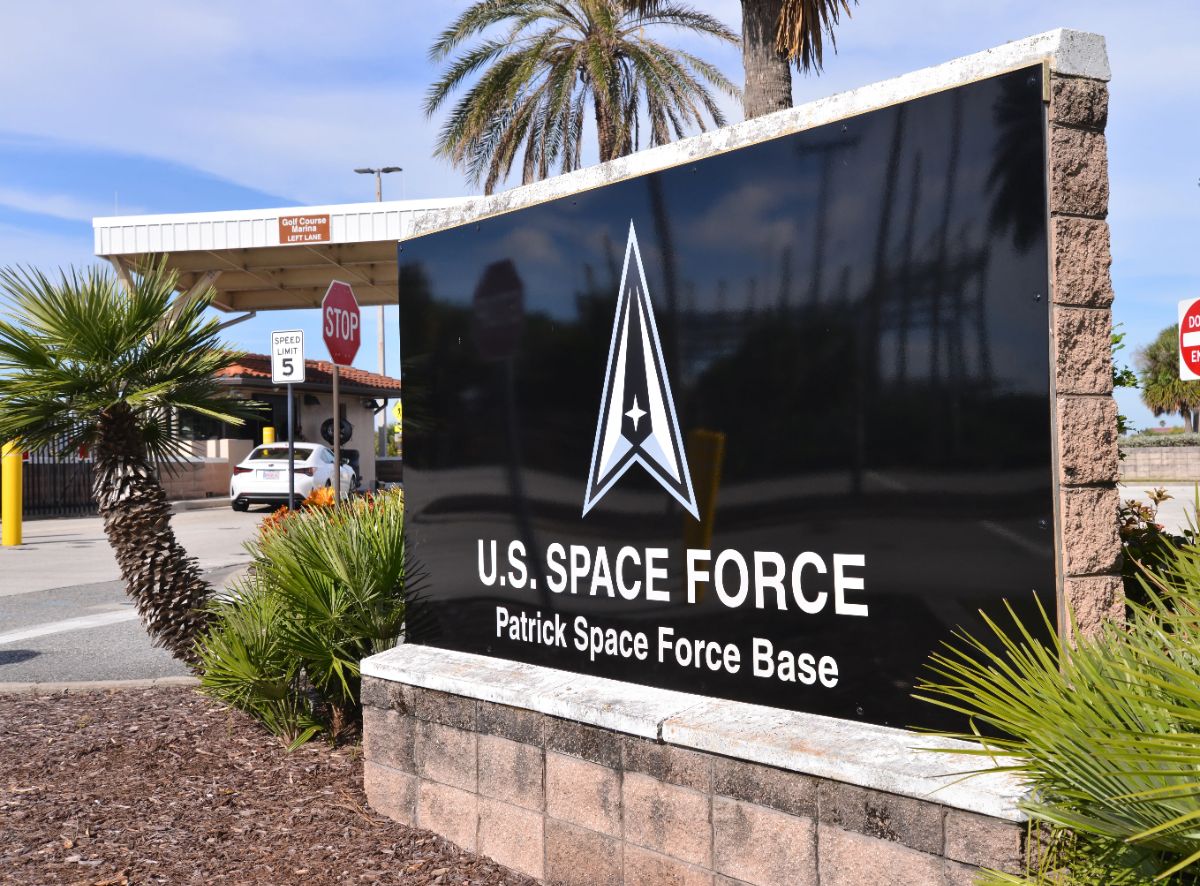
Patrick Space Force Base was selected as the headquarters for Space Training and Readiness Command (STARCOM), responsible for preparing combat-ready space forces. The base supports approximately 75 tenant units and mission partners, generating 10,400 jobs. The Eastern Range command and control systems that monitor every rocket launch from the East Coast are managed from this single installation.
The Strategic Vulnerability No One Is Discussing
Now consider what a sophisticated adversary sees when it looks at Brevard County.
A single strike zone that delivers cascading strategic effects. Unlike the Pentagon—which is symbolically important but doesn’t manufacture or test weapons—Brevard County is operationally irreplaceable. Unlike Huntsville, Alabama, which has missile defense expertise but no launch infrastructure, Brevard stacks every layer of the defense stack in one coastal strip.
No other single county in the United States simultaneously houses:
The sole national nuclear treaty monitoring center. The primary testing facility for submarine-launched nuclear missiles. The nation’s primary East Coast space launch complex. The headquarters of a top-five global defense contractor. Major campuses of Northrop Grumman, Lockheed Martin, Boeing, SpaceX, and Blue Origin. Space Force training command headquarters. The Eastern Range command and control center.
An adversary doesn’t need to occupy Brevard County. They need to disable it. And the cascading effects of doing so would be devastating:
1. Blinding the Nuclear Watchdog
Disabling AFTAC eliminates America’s real-time ability to detect nuclear detonations worldwide. An adversary could conduct clandestine nuclear tests—or prepare for a nuclear first strike—while the U.S. is flying blind. This isn’t theoretical. AFTAC’s seismic detection capabilities were what confirmed North Korea’s nuclear tests. Without AFTAC, we don’t know what we don’t know.

2. Crippling the Nuclear Triad’s Most Survivable Leg
Destroying NOTU’s testing infrastructure doesn’t sink our submarines—but it guts our ability to develop, test, and certify the missiles they carry. The Trident D5LE2 program, designed to arm Columbia-class boats for the next 60 years, cannot proceed without the specialized labs and testing facilities now being built at Cape Canaveral. You don’t need to beat the submarine force if you can starve it of the weapons it needs.
3. Opening the South Atlantic Approaches
The Eastern Range’s tracking, telemetry, and surveillance systems monitor a vast swath of the Atlantic. These same systems contribute to domain awareness of what’s moving through those waters. Degrading them creates a surveillance gap that enemy submarines, surface vessels, and cruise missile platforms could exploit to approach the U.S. southeastern coastline—home to major population centers, Naval Station Mayport, and Kings Bay submarine base in Georgia.
4. Eliminating Satellite Surge Capability
In a peer conflict, the opening salvos will target space assets—GPS, communications, reconnaissance. America’s ability to rapidly launch replacement satellites is critical to maintaining battlefield advantage. Cape Canaveral is the primary facility for this mission. Vandenberg cannot fully compensate, especially for geostationary orbit insertions that require eastward launches over open ocean. Lose the Cape and America fights the next war partially deaf and blind in space.
5. Decapitating Defense Industrial Capacity
The engineers and scientists working on the B-21 stealth bomber, Trident missile systems, satellite integration, electronic warfare, and rocket propulsion represent intellectual capital that cannot be quickly reconstituted. L3Harris’s satellite manufacturing, Northrop Grumman’s radar and aerospace programs, Lockheed’s missile work—this human capital is concentrated in Brevard to a degree that should alarm strategic planners.
The Geographic Reality Makes It Worse
Brevard County’s geography amplifies the vulnerability. Patrick Space Force Base sits at approximately seven feet above sea level, directly on the Atlantic coast. The entire corridor from Titusville to Palm Bay is a narrow barrier island and coastal strip with minimal terrain for natural defense.
Unlike Cheyenne Mountain, buried under 2,000 feet of granite in Colorado, these facilities are exposed to sea-based cruise missile attack, submarine-launched weapons, hypersonic glide vehicles, and even conventional naval strike. A submarine operating in the Atlantic could launch cruise missiles at Brevard County targets with flight times measured in minutes, not hours.
The low elevation also makes the entire corridor vulnerable to electromagnetic pulse effects, which propagate farther over flat, conductive terrain—exactly what a coastal salt marsh and barrier island provide.
What Should Be Done
This is not an argument against Brevard County’s defense role—these facilities exist where they are for excellent reasons, including geography, history, and workforce. But concentration of this magnitude demands a serious conversation about resilience:
Redundancy for AFTAC. The nation’s nuclear treaty monitoring capability should not have a single point of failure. A geographically dispersed backup operations center—possibly co-located with existing NORAD or Strategic Command facilities—would ensure continuity of this irreplaceable mission.
Hardening of critical infrastructure. Key facilities at Patrick Space Force Base and Cape Canaveral should receive hardening upgrades against blast, EMP, and cyber attack. The investment in new NOTU infrastructure is welcome but should incorporate resilience measures from the design phase.
Enhanced coastal defense. The southeastern Atlantic seaboard requires expanded anti-submarine warfare patrols, coastal radar networks, and integrated air and missile defense coverage commensurate with the value of the assets being protected.
Strategic dispersal planning. Congress should commission a study on reducing single-point-of-failure risk for America’s most concentrated defense industrial corridor. Some functions can and should be distributed to reduce the catastrophic potential of a focused attack.
Classification review. The specific capabilities and vulnerabilities of Brevard County’s defense infrastructure should be the subject of a classified threat assessment, if one does not already exist, examining adversary targeting doctrine and capability.
The Bottom Line
We have inadvertently created the single most strategically valuable—and vulnerable—target in the continental United States. Brevard County, Florida, is not just another military town. It is the linchpin of American nuclear deterrence, space launch capability, missile defense development, and defense industrial capacity.
Our adversaries have war planners whose job is to identify exactly these kinds of concentrations. China’s military doctrine explicitly emphasizes striking “system destruction” targets—nodes whose elimination creates cascading failures across an enemy’s entire defense architecture. Brevard County is a textbook example of such a node.
It’s time for America to have an honest conversation about whether we’ve put too many eggs in one very exposed basket—and what we’re going to do about it before an adversary does it for us.
The views expressed in this article are those of the author and do not necessarily reflect the official position of any government agency or military branch.