Military strength, war history, economy, alliances, social law, religion, and global rankings — a comprehensive reference for American readers navigating the most consequential confrontation in the Middle East since the 2003 Iraq invasion.
01 Executive Summary
Iran is a nation of striking contradictions. It is the 17th largest country on earth, home to one of the most ancient and sophisticated civilizations in human history, and currently the 16th most powerful military force on the planet — yet its people are impoverished by sanctions, surveilled by morality police, and watching their currency collapse in real time.
As of March 2026, Iran is engaged in active military conflict. On February 28, 2026, joint U.S.-Israeli strikes — code-named Operation Epic Fury — targeted key command infrastructure inside Iran. Supreme Leader Ali Khamenei was killed in a strike on Tehran. Iran responded by firing ballistic missiles at U.S. military installations across Qatar, Kuwait, the UAE, Bahrain, and Jordan — the largest Iranian missile barrage against American forces in history.
What follows is the most comprehensive open-source intelligence profile of Iran assembled for an American audience: its military, its economy, its laws, its religion, its alliances, and the strategic logic that drove this conflict to its current flashpoint.
02 Geography & Size
Iran covers approximately 636,372 square miles — roughly five times the size of California, and larger than the combined area of France, Germany, Spain, and the United Kingdom combined. It is the 17th-largest country on earth and the second-largest in the Middle East after Saudi Arabia. Its terrain is dominated by two massive mountain ranges — the Zagros and the Alborz — with a central plateau of arid desert that makes large-scale ground invasion extraordinarily difficult. Iran controls 1,500 miles of Persian Gulf and Gulf of Oman coastline, including the Strait of Hormuz — the single most strategically critical waterway on earth, through which approximately 20% of global oil supply flows daily.
Iran vs. Middle East — Area Rankings | |||
Rank | Country | Area (sq mi) | Global Rank |
|---|---|---|---|
1 | Saudi Arabia | 830,000 | 13th |
2 | IRAN | 636,372 | 17th |
3 | Egypt | 386,662 | 30th |
4 | Turkey | 302,535 | 37th |
5 | Yemen | 203,850 | 49th |
6 | Iraq | 169,235 | 58th |
03 Demographics & Population
Iran's population is approximately 93 million as of 2026, making it the 17th most populous country on earth. The median age is 32 years — young by Western standards but rapidly aging as the fertility rate has fallen to 1.44 children per woman, well below the replacement rate of 2.1. This is lower than Germany, France, and most of Eastern Europe. The regime is actively running pro-natalist campaigns; young Iranians are not complying.
Ethnic composition: Persians (~61%), Azerbaijanis (~16%), Kurds (~10%), Arabs (~2%), Baloch (~2%), and others. While Persian is the official language, over 40% of Iranians speak a Turkic dialect (primarily Azerbaijani) as their first language — a demographic tension the government has historically suppressed. Iran has an adult literacy rate of 88.9% and a youth literacy rate approaching 97-98%. Women are a majority of Iranian university students in many disciplines — a demographic paradox that directly fuels the "Woman, Life, Freedom" protest movement.
Life expectancy stands at approximately 77.5 years — above the global average of 73 and above neighboring Iraq at 69.5. Despite the sophistication of its educated class, the IMF ranks Iran #1 in the world for brain drain, with 150,000–200,000 educated professionals emigrating annually. All 10 top students from Iran's 2008 and 2009 national entrance exams have emigrated.
04 Economy: A Sanctions-Strangled Giant
Iran is a country that should, by any objective measure, be prosperous. It sits on the world's second-largest proven natural gas reserves and the fourth-largest proven oil reserves. It is a top-10 global oil and gas producer with a large, educated population and significant industrial capacity. Instead, it is an economic prisoner of its own government's foreign policy choices.
GDP in purchasing power parity terms stands at approximately $1.486 trillion — ranking Iran 23rd globally. In nominal dollar terms, however, per capita GNI is approximately $4,650 USD — placing Iran squarely in middle-income territory, comparable to Iraq ($5,600) but a fraction of the United Kingdom ($47,700). The annual inflation rate exceeded 40% officially in 2025, while the black market rial lost 62% of its value against the U.S. dollar in the 12 months ending January 2025 — destroying middle-class savings and triggering the December 2025 protests that escalated into the current conflict.
Iran's Export Profile
Iran Export Profile by Category | ||
Export Category | Approx. % of Exports | Notes |
|---|---|---|
Mineral Fuels — Oil, Gas, Petroleum Products | ~48–80% | China is primary buyer; ~1.38M barrels/day in 2025; discounted as low as $14/barrel below market |
Manufactured Products | ~37% | Petrochemicals, steel, cement, plastics, pharmaceuticals |
Food & Agricultural Products | ~8% | Pistachios (#1 global exporter), saffron, dates, dried fruits, fish products |
Ores and Metals | ~6–7% | Iron ore, copper, zinc, aluminum |
Persian Carpets / Handicrafts | ~1–2% | $500M+ annually; 1.2M weavers; once 30% of global hand-woven carpet market |
Defense / Weapons Exports | Classified / Growing | Shahed drones to Russia ($2.7B+ in sales); Fateh-110 ballistic missiles; kamikaze drone variants |
Total Exports (2023) | ~$100.5B USD | Trade surplus vs. ~$79.4B imports — despite full sanctions regime |
Economic Vulnerabilities
Sanctions have cut Iran off from the SWIFT international banking system, blocked foreign direct investment, and driven away multinational firms. The IRGC controls an estimated 20–40% of the Iranian economy through front companies — making genuine economic reform politically impossible without dismantling the power base of the institution that defends the regime. The December 2025 protests — which began as economic demonstrations against 40%+ inflation — ultimately provided the political pretext that enabled the current military escalation.
Key Economic Vulnerability
Iran's female labor force participation rate is one in ten working-age women — among the lowest rates globally. This represents the single largest untapped economic resource in the country, deliberately suppressed by legal barriers and social policy. In a different political framework, this workforce alone could add 15–20% to national GDP output.
Intelligence Map · March 2026 · Active Conflict Zone
U.S. & Allied Military Bases Surrounding Iran
40,000–50,000 U.S. personnel deployed across 10+ countries | Largest military buildup in the Middle East since the 2003 Iraq invasion | Each flag marks an active or cooperative U.S. military installation
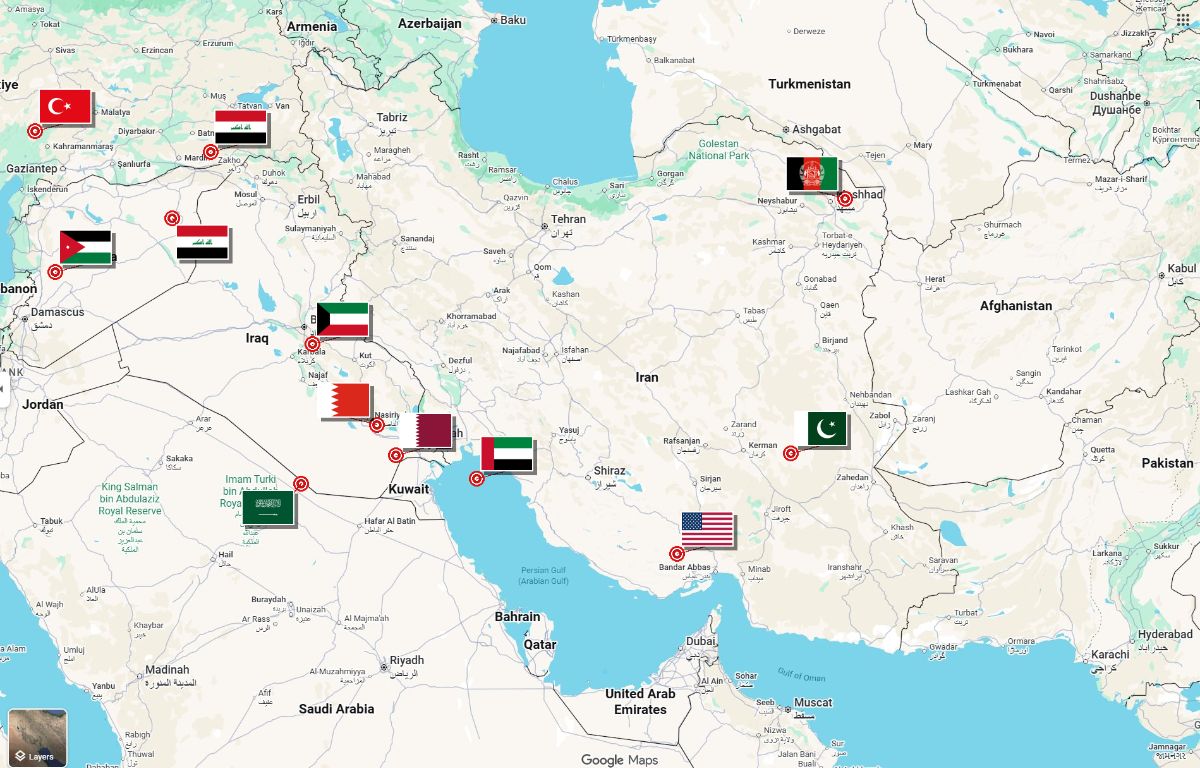
Sources: U.S. CENTCOM · Council on Foreign Relations · GlobalFirepower 2026 · Reuters | americafirstnews.us | AFN Research & Analysis Division · 08 March 2026
05 The Iron Ring: U.S. Military Bases Surrounding Iran
Iran is one of the most heavily encircled nations on earth from a military standpoint. The United States maintains a network of permanent and semi-permanent military installations across at least 10 countries surrounding Iran — a geographic reality that the Iranian leadership cites as the primary justification for its nuclear program, its ballistic missile buildup, and its proxy network strategy. Understanding this encirclement is essential to understanding every major Iranian foreign policy decision since 1979.
U.S. Military Installations Surrounding Iran — March 2026 | |||
Base / Installation | Country | U.S. Personnel | Strategic Role |
|---|---|---|---|
Al Udeid Air Base | Qatar | ~10,000 (CENTCOM HQ) | Largest U.S. base in Middle East; CENTCOM forward HQ; targeted by Iranian missiles Feb 28, 2026 |
NSA Bahrain | Bahrain | ~9,000 | U.S. Navy 5th Fleet HQ; attacked Feb 28, 2026 |
Camp Arifjan / Ali Al Salem / Buehring | Kuwait | ~13,500 (largest) | U.S. Army Central HQ; staging ground into Iraq and Syria |
Al Dhafra Air Base | UAE | ~3,500 | F-35s, F-22s, surveillance aircraft; targeted Feb 2026 |
Prince Sultan Air Base | Saudi Arabia | ~2,300+ | Patriot + THAAD missile defense; advanced strike operations |
Muwaffaq Salti Air Base | Jordan | ~3,000+ | F-15E Strike Eagles deployed Feb 2026; Jordan targeted by Iran in current conflict |
Ain Al Asad + Erbil Air Bases | Iraq | ~2,500 | NATO mission support; previously struck after Soleimani killing (2020) |
Incirlik Air Base | Turkey (NATO) | ~1,500 + nuclear weapons | NATO asset; stores ~50 B61 nuclear gravity bombs under NATO sharing agreement |
Camp Lemonnier | Djibouti | ~4,000 | U.S. sole permanent base in Africa; controls Red Sea and Gulf of Aden |
RAF Akrotiri (UK base, U.S. access) | Cyprus | Classified | Targeted by Iran-backed Hezbollah drones Feb 2026 — first attack on European soil in this conflict |
Jacobabad / Shamsi Air Base | Pakistan | Cooperative access | Historical staging; drone and ISR operations; informal U.S. access |
2 Carrier Strike Groups | Arabian Sea | 10,000+ sailors | USS Abraham Lincoln + USS Gerald R. Ford; ~130 combined combat aircraft |
Total Regional Forces | 10+ countries | 40,000–50,000 | Largest U.S. buildup in Middle East since 2003 Iraq invasion |
"The geographic reality of American military encirclement is the single most important factor in understanding Iranian foreign policy — including the nuclear program, the missile buildup, the proxy network, and the refusal to negotiate from a position of perceived weakness."
06 Military Profile
Iran's armed forces represent one of the most unusual military structures in the world: a dual-track system in which the conventional military (Artesh) and the ideologically-driven Islamic Revolutionary Guard Corps (IRGC) operate in parallel, with the IRGC controlling the most strategically important assets — ballistic missiles, drones, proxy forces, and intelligence operations. The IRGC also controls 20–40% of the civilian economy through front companies, creating a military-industrial complex with no Western parallel.
Military Personnel by Branch — 2026 | ||
Branch / Force | Active Personnel | Notes |
|---|---|---|
Regular Army (Artesh) | 350,000 | Ground forces, territorial defense |
IRGC (Islamic Revolutionary Guard Corps) | 190,000 | Missiles, drones, proxy ops — ideologically vetted |
Air Force | 37,000 | ~250 combat aircraft (largely 1970s-era Shah fleet) |
Navy | 18,000 | 107 naval assets; Persian Gulf asymmetric focus |
Air Defense / Gendarmerie / Para. | 55,000 | Air defense + internal security |
Reserve Forces | 350,000 | Army veterans + volunteers |
Basij Militia | Up to 1,000,000+ | Paramilitary mobilization capacity; ideological backbone |
Total Mobilization Potential | ~1,000,000+ | World's 16th most powerful military (Global Firepower 2026) |
Key Arsenal Capabilities
Key Arsenal Capabilities | ||
Weapons System | Quantity / Scale | Significance |
|---|---|---|
Ballistic Missiles | 3,000+ (largest in Middle East) | Khorramshahr-4: 2,000 km range; Fattah hypersonic: Mach 13–15 |
Main Battle Tanks | ~1,500–1,713 | T-72s, domestic Zulfiqar and Karrar models |
Artillery Systems | ~7,000 | Towed guns + MLRS rocket launchers |
Combat Aircraft | ~250 operational | Weakest branch; many 1970s-era U.S.-origin frames (F-14, F-4) |
UAV / Drone Fleet | Large — domestic production | Shahed-136 exported to Russia; Arash-2 loitering munitions |
Naval Assets | 107 total vessels | Asymmetric naval warfare; midget submarines; fast attack craft |
Defense Budget (2025–26) | ~$7.9B–$15B (est.) | 12–20% of total government spending; wartime conditions accelerating |
07 Iran's Alliances: China, Russia & the 'Look East' Pivot
The Strategic Logic
Isolated from Western financial markets, cut off from legal arms purchases by international embargo, and facing the world's most comprehensive sanctions regime, Iran had no viable option but to pivot eastward. The 25-year Comprehensive Cooperation Agreement with China (signed 2021, ratified 2023) and the 20-year Comprehensive Strategic Partnership with Russia (January 2025) represent Iran's formal alignment with the emerging anti-Western axis — a bloc that also includes North Korea, Belarus, and Venezuela.
In practice, this relationship is more asymmetric and transactional than Tehran publicly acknowledges. China buys Iranian oil at steep discounts — as much as $14 per barrel below market — saving Beijing an estimated $7 billion per year while simultaneously maximizing Iran's dependence on a single buyer. Russia has used Iran as an arms supplier rather than an arms provider in the Ukraine conflict — Iran sold Russia over 4,600 Shahed drones and approximately 400 Fateh-110 ballistic missiles worth $2.7 billion, reversing the traditional patron-client dynamic.
Critically: neither China nor Russia has military bases in Iran, nor has either deployed combat forces there. China's strategic doctrine since 1978 prohibits overseas military entanglements. Russia's interest is in using Iran as a weapons supplier and oil market disruptor — not in defending Iranian territory. Both countries voted for UN sanctions against Iran's nuclear program before the JCPOA and could do so again.
Documented China & Russia Technology Transfers to Iran (2022–2026) | ||
Supplier | Category | Specific Transfers / Actions |
|---|---|---|
CHINA | Missile Propellant | Feb 2025: 1,000 tons sodium perchlorate — fuel for ~200–300 Haj Qasem / Kheibar Shekan ballistic missiles |
CHINA | Air Defense Systems | HQ-9B, HQ-16, HQ-17AE surface-to-air missiles; delivered summer 2025 to rebuild defenses after 12-Day War |
CHINA | Satellite Intelligence | Chang Guang / Jilin-1 constellation: round-the-clock optical/radar surveillance of U.S. and Israeli bases |
CHINA | Navigation Systems | Iran transitioned from U.S. GPS to encrypted Chinese BeiDou-3 military signals for all missiles |
CHINA | AI / Guidance | AI targeting systems integrated into Shahed-136 drones (confirmed June 2025 wreckage analysis) |
CHINA | Anti-Ship Missiles (Pending) | CM-302 (YJ-12) supersonic anti-ship missiles — negotiations near completion; would dramatically strengthen Strait of Hormuz defense |
RUSSIA | Spy Satellite | Khayyam (2022): Russian-built Kanopus-V, 1.2m resolution; Iran monitors U.S./Israeli military installations in real time |
RUSSIA | Fighter Jets | 48 Su-35 'Flanker-E' jets (~$6.5B deal); deliveries began early 2026; Irbis-E radar designed to detect F-35 stealth aircraft |
RUSSIA | Air Defense | Dec 2025: ~$590M deal — Verba MANPADS + S-300 batteries; radar modernization and electronic warfare integration |
RUSSIA | Attack Helicopters | Mi-28 'Night Hunter' attack helicopters; Yak-130 combat trainers; 20-year Strategic Partnership Treaty signed Jan 2025 |
IRAN → RUSSIA | Drone / Missile Exports (Reverse) | 4,600+ Shahed suicide drones + ~400 Fateh-110 ballistic missiles for Ukraine war ($2.7B+ in sales) — patron-client dynamic reversed |
Cultural Tensions Beneath the Alliance
The alliance with China and Russia is strategically convenient but culturally strained — a marriage of necessity, not affection. Iranian national identity is deeply Persian, with a 3,000-year history of sophisticated civilization that predates both the Chinese Communist Party and the Russian state as currently constituted. Many educated Iranians view Chinese investment as economic colonization — Chinese companies have taken large stakes in Iranian infrastructure at below-market terms in exchange for discounted oil purchases. Russia occupies an even more fraught place in Iranian historical memory: the Russo-Persian Wars of the 19th century stripped Iran of its Caucasian territories, and Soviet occupation during World War II remains a living wound in Iranian national consciousness.
08 Social Law, Moral Code & Human Rights
The Islamic Republic of Iran operates under Sharia-derived law as interpreted by its Shia Twelver clerical establishment. The legal code is not merely religious guidance — it is enforced by morality police, state surveillance, and a judicial system in which clerics serve as judges with power to impose physical punishment. What follows is a factual accounting of how Iranian law treats personal and social conduct.
Women's Rights: A Study in Contradictions
Iran presents a paradox on women's rights that defies simple categorization. On one hand, Iranian women have among the highest university enrollment rates in the Middle East — in many disciplines, women outnumber men. On the other hand, the legal framework governing their daily lives is among the most restrictive in the world. Only 1.2 in 10 working-age women are formally employed — one of the lowest rates on earth.

Hijab / Dress Code: Compulsory Islamic hijab is enforced by morality police (Gasht-e Ershad). Women can be arrested, fined, flogged, and imprisoned for what authorities deem inadequate head covering. The enforcement crackdown intensified after the 2022 Mahsa Amini protests.
Marriage: Legal marriage age for girls is 13. Women must have a male guardian's permission to marry for the first time. Women cannot pass Iranian nationality to children of foreign fathers; men can. Divorce: Men may divorce wives unilaterally without cause (talaq). Women must petition a court, meet narrow legal grounds, and typically forfeit their dowry if they initiate divorce. Inheritance: Daughters inherit half the share of sons. Widows receive one-eighth of their husband's estate if there are children. Domestic Violence: Iran has no domestic violence laws. Spousal abuse is not a criminal offense under current Iranian statute.
Court Testimony: A woman's legal testimony is worth half that of a man's. In certain capital cases, female testimony is not accepted at all. Abortion: Illegal in virtually all circumstances — exceptions exist only to save the mother's life before the fourth month (120 days), and only with the husband's consent and court approval.
Homosexuality
Same-sex sexual activity between men is a capital offense under Iranian law. The prescribed punishment under the Islamic Penal Code is death — by hanging, though stonings have also occurred historically. The Iranian government simultaneously funds and subsidizes gender reassignment surgery as an alternative to homosexuality — operating under the religious theory that transsexuality is a medical condition entirely distinct from homosexuality. Iran is simultaneously the world's largest state sponsor of gender reassignment surgery and a country that executes gay men.
Freedom of Speech, Press & Assembly
Iran ranks near the bottom globally on press freedom indices. Independent journalism is effectively banned. Social media platforms including Instagram, Twitter/X, WhatsApp, and virtually all Western services are blocked by the state firewall. In January 2026, the government cut internet access to major cities during the height of the December 2025 protests. Journalists and bloggers are routinely imprisoned under cybercrime and national security statutes.
09 Shia vs. Sunni Islam: The Split That Shapes the Middle East
The Shia-Sunni divide is the single most important religious and geopolitical fault line in the Muslim world. It originated 1,400 years ago as a dispute over political succession after the death of the Prophet Muhammad in 632 CE and has since evolved into a civilizational rivalry that drives the majority of armed conflicts in the Middle East today. To understand Iran's foreign policy, its proxy network, and its rivalry with Saudi Arabia, you must understand this split.
Shia vs. Sunni Islam — Key Differences | ||
Dimension | Shia Islam (Iran's Faith) | Sunni Islam (Global Majority) |
|---|---|---|
Global Share | ~10–15% of Muslims (~200M) | ~85–90% of Muslims (~1.6B) |
Primary Countries | Iran, Iraq, Azerbaijan, Bahrain, Lebanon | Saudi Arabia, Egypt, Turkey, Indonesia, Pakistan, most of North Africa |
Origin of Split | Believed leadership must remain in Prophet Muhammad's family — Ali ibn Abi Talib | Believed the community should elect the most qualified leader — chose Abu Bakr |
Foundational Event | Battle of Karbala (680 CE) — Hussein ibn Ali killed; Ashura mourning observance | Recognition of four 'rightly guided' caliphs as legitimate successors |
Religious Authority | Grand Ayatollahs; Iran's Velayat-e Faqih places political power in a Supreme Cleric | No single supreme authority; Saudi Wahhabi/Salafi tradition wields global influence |
Prayer Practices | 5 daily prayers; may combine mid-day and afternoon into 3 sessions | 5 fully separate prayer sessions daily |
Geopolitical Alignment | Iran leads 'Axis of Resistance': Hezbollah, Houthis, Hamas, Shia militias in Iraq | Saudi Arabia leads Sunni bloc; Riyadh-Tehran rivalry drives most Mideast conflicts |
Iran is the world's only Shia theocracy and the self-declared leader of the global Shia community — a community that, while a global minority, represents the majority in Iran, Iraq, Azerbaijan, and Bahrain. The Islamic Republic has deliberately cultivated Shia identity as a tool of geopolitical influence, funding Shia proxies across the region. The Sunni-Shia divide also means Iran has limited natural allies in the Arab world — most Arab states are Sunni-majority and view Iran with deep suspicion regardless of their public posture toward the West.
10 War History: 400 Years of Conflict
Iran's military history reflects a largely defensive pattern: it has far more often been invaded or occupied than it has successfully projected force abroad. The 20th century in particular saw Iran occupied or invaded three separate times by foreign powers — twice despite declaring neutrality. This history of foreign invasion directly informs contemporary Iranian security paranoia, including the nuclear program, the missile buildup, and the reflexive hostility to Western military presence in the region.
Modern War Timeline (1800s–Present) | ||
Conflict | Dates | Outcome / Significance |
|---|---|---|
Russo-Persian Wars | 1804–1828 | Iran lost Caucasus territories (present-day Armenia, Azerbaijan, Georgia) to Russia through humiliating Treaties of Gulistan and Turkmenchay. |
Anglo-Persian War | 1856–1857 | Iran's attempt to reclaim Herat (Afghanistan) defeated by Britain. Forced to permanently renounce Afghan territorial claims. |
World War I (Persian Campaign) | 1914–1918 | Iran declared neutrality; occupied anyway by Ottoman, British, and Russian forces. Catastrophic famine killed hundreds of thousands of civilians. |
Anglo-Soviet Invasion | 1941 | Allies invaded despite Iranian neutrality to secure the 'Persian Corridor' supply route to Soviet Russia. Reza Shah forced to abdicate. |
Iran-Iraq War | 1980–1988 | Iraq invaded first under Saddam Hussein. Eight years of brutal attrition warfare; 500K–1M combined casualties. Iraq used chemical weapons — 30,000 Iranians still suffer effects today. |
Syria / Yemen / Iraq Proxy Operations | 2011–present | IRGC advisors in Syria; Houthi arming in Yemen; Shia militia backing in Iraq. Iran allocated ~$50B to maintain the Assad regime before its collapse. |
Israel–Iran 12-Day War | June 2025 | Israel struck nuclear and military sites. Iran retaliated with hundreds of ballistic missiles. U.S. entered June 22 with bunker-busters on Natanz, Fordow, Isfahan. Ceasefire June 24. |
Operation Epic Fury | Feb 28, 2026–present | Active conflict. Joint U.S.-Israeli strikes; Supreme Leader Khamenei killed in Tehran. Iran retaliates with missiles against U.S. bases in Qatar, Kuwait, UAE, Bahrain, and Jordan. |
11 Iran at a Glance: World Rankings Summary
Consolidated Global Rankings — March 2026 | ||
Category | Iran's Rank / Value | Context |
|---|---|---|
Military Power (Global Firepower 2026) | #16 of 145 nations | #1 active troops in Middle East |
Land Area | #17 globally | 2nd largest in Middle East after Saudi Arabia |
Population (2026) | ~93M (#17 globally) | Median age 32; fertility rate 1.44 (below replacement) |
Life Expectancy | ~77.5 years | Above world avg 73; above Iraq 69.5 |
Adult Literacy | 88.9% (#94 of 162) | Youth literacy 97–98%; women majority of university students |
Brain Drain Index | #1–2 globally (IMF) | ~150–200K educated professionals leave annually |
GNI Per Capita | ~$4,650 USD | vs. UK $47,700; Iraq $5,600 |
GDP (Purchasing Power Parity) | $1.486T (#23 globally) | Top 10 oil & gas producer; sanctions suppress actual output |
Annual Inflation Rate (2025) | 40%+ official | Black market rial lost 62% vs. USD in 12 months ending Jan 2025 |
GDP Growth (2025 projection) | ~0.3% (near zero) | Worst performance since 2019; war damage accelerating in 2026 |
Ballistic Missile Arsenal | #1 in Middle East (3,000+) | Largest and most diverse missile inventory in the region |
Infant Mortality | 14.3 per 1,000 births | vs. Iraq 18.7; UK 3.8 |
Female Labor Force Participation | 1.2 in 10 women employed | One of the lowest rates globally |
12 10 Facts Most Americans Don't Know About Iran
10 Things You Weren't Taught in School
1
Iran invented human rights. The Achaemenid Empire under Cyrus the Great (550 BCE) issued one of history's first declarations of human rights — predating Magna Carta by nearly 1,800 years. The Cyrus Cylinder is housed in the British Museum.
2
Iran's air force is its weakest branch. Operating fewer than 250 combat aircraft — many dating to the Shah era of the 1970s — Iran compensates with the Middle East's largest ballistic missile arsenal: 3,000+ missiles across 19 distinct systems.
3
Iran leads the world in brain drain. The IMF ranks Iran #1 globally in the flight of educated professionals. All 10 top students from Iran's 2008 and 2009 national entrance exams have emigrated. Approximately 150,000–200,000 educated professionals leave annually.
4
Women are a majority of university students. Despite living under one of the world's most restrictive theocracies, women outnumber men at Iranian universities in many disciplines. This demographic directly fuels the 'Woman, Life, Freedom' protest movement.
5
Iran's missiles use Chinese GPS, not American. Iran transitioned from U.S. GPS to China's encrypted BeiDou-3 military navigation signals — meaning U.S. GPS degradation campaigns in the conflict theater have zero effect on Iranian strike accuracy.
6
Iran was neutral in both World Wars — and occupied in both. Allied forces invaded Iran in 1914–18 and again in 1941 despite official declarations of neutrality. This history of foreign invasion directly informs contemporary Iranian security doctrine.
7
The U.S. and Iran were close military allies until 1979. The Shah spent $8 billion on American weapons between 1971–1975 alone. Iran's air force today still flies those same U.S.-made aircraft — maintained for 47 years without American spare parts through reverse engineering.
8
Iran is the world's largest state funder of gender reassignment surgery. It subsidizes it as a religious and legal alternative to homosexuality — while simultaneously executing gay men under the Islamic Penal Code. Both policies coexist in the same legal framework.
9
Iran's rial lost 62% of its value in 12 months. The currency collapse ending January 2025 pushed large segments of the middle class into poverty and triggered the December 2025 protests that ultimately escalated into the current armed conflict.
10
Iran's birth rate is now lower than Germany's. At 1.44 children per woman, Iran's fertility rate is below the replacement rate of 2.1 and lower than most of Western Europe. The regime is running pro-natalist campaigns. Young Iranians are not complying.
Sources & References
Council on Foreign Relations — U.S. Military Bases in the Middle East
Wall Street Journal — Iran-China-Russia Military Cooperation
AMERICA FIRST NEWS™ Research & Analysis Division | americafirstnews.us | 08 March 2026